



According to naval historian R.D. Hill:
"The (ironclad) had three chief characteristics: a metal-skinned hull, steam propulsion, and a main armament of guns capable of firing "explosive shells. It is only when all three characteristics are present that a fighting ship can properly be called an ironclad." USS Monitor has not been the first ironclad in the world. In 1854 during the Crimea War French used armored floating batteries Lave, Tonnante, and Devastation. Warships the attack on Russian coastal fortifications. Three years later the French built the first wooden-hulled armored frigate “La Gloireloire”. The Royal Navy gave a swift and strong response. In 1860 HMS Warrior was built Warrior the first iron-hulled and iron-plated warship in the world.
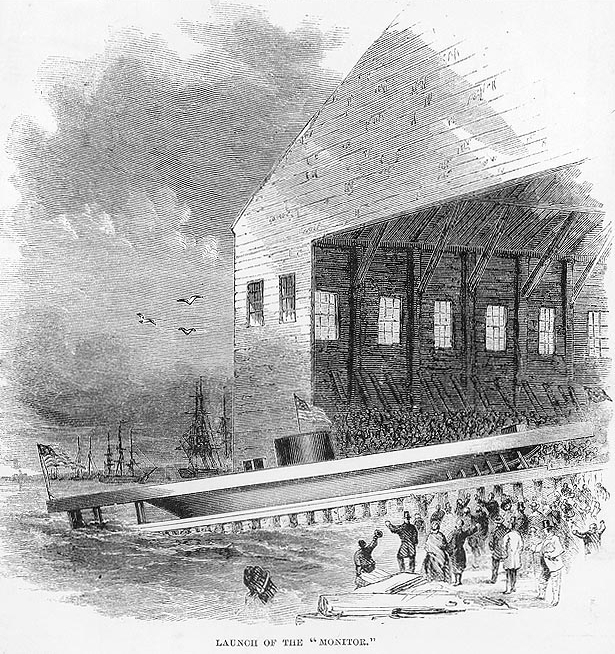 The US Navy at the time the Civil War broke out had no ironclads. In August 1861 the Union authorities heard that Confederates were going to convert the captured hull of the steam frigate “USS Merrimack” into an ironclad. In response, Union decided to build build his ironclads. Two seagoing vessels; an armored gunboat “USS Galena”, a broadside frigate “USS New Ironsides” and one offshore floating battery “USS Monitor”.
Construction.
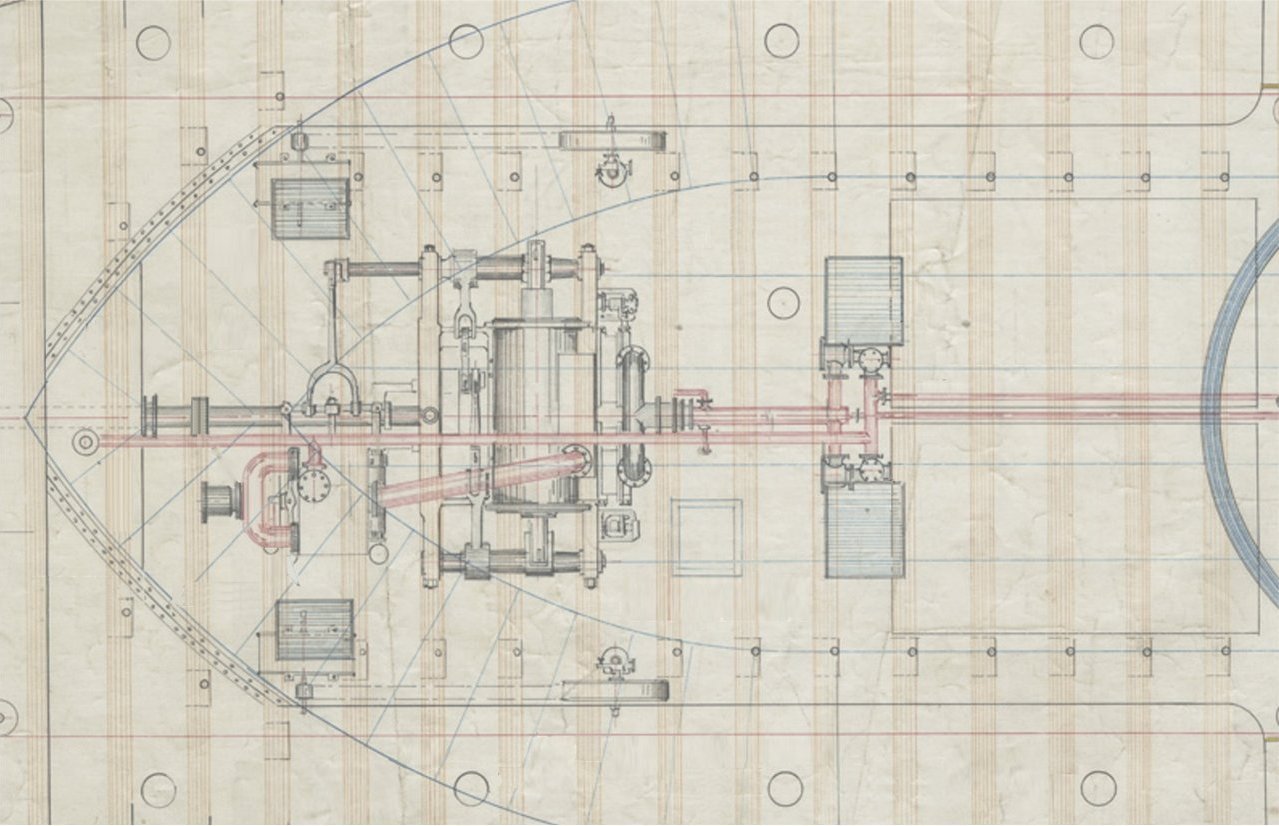
Designed by the Swedish engineer John Ericsson, "Monitor" was described as a "cheesebox on a raft," because the key point of Ericsson's idea was a revolving turret and flat hull with very low ship sides. "Monitor" had an unusually low freeboard, with the pilothouse and turret being the only permanent protrusions from the deck. Though this low freeboard greatly reduced the "Monitor's" vulnerability to gunfire compared to other naval vessels of the day, it also greatly reduced the ship's seakeeping capabilities. The sides were low because the low side is much easier to protect than the high side. The hull was constructed in two parts, the upper portion sitting on top of the conventionally lower hull like the raft. It was protected by two ½ inch plates laid over the deck beams and 5 inches of side armor in 1-inch strips, backed by 25 inches of oak. The purpose of the raft was to protect the hull and the propeller against artery shots and ramming by other ships.
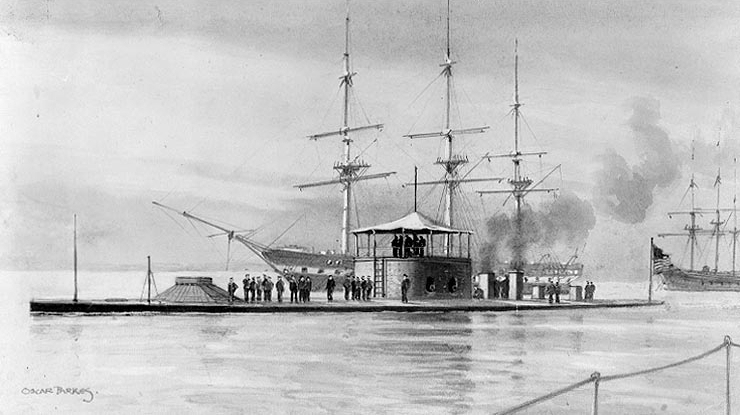 Air intakes and smoke holes were protected by iron grating. The gun turret on the deck, housing two 11 in (280 mm) Dahlgren guns, paired side by side. The original design used a system of heavy metal shutters to protect the gun ports while reloading. However, the operation of the shutters proved so cumbersome, that the gun crews simply rotated the turret away from potential hostile fire to reload. Further, the momentum of the rotating turret proved to be so great that a system for stopping the turret from firing the guns was implemented on later models of ships in the Monitor class. The crew of "Monitor" solved the turret momentum problem by firing the guns on the fly while the turret rotated past the target. While this procedure resulted in a substantial loss of accuracy, the loss of accuracy was not critical, given the close range at which the Monitor operated. The turret comprised eight layers of 1 in (25 mm) plate, bolted together, with a ninth plate inside to act as a sound shield. The pilot house on the bow of the ship contains the ship's wheel and captain post. The screw has been powered by two steam engines designed by Ericsson himself, and other smaller engines powered the turret and ventilation system. The monitor was launched on 30 January 1862 and commissioned to service one month later.
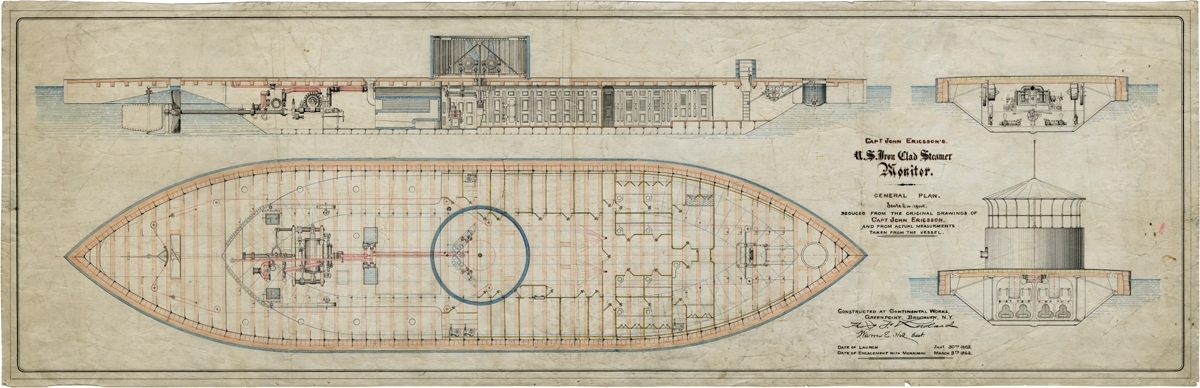
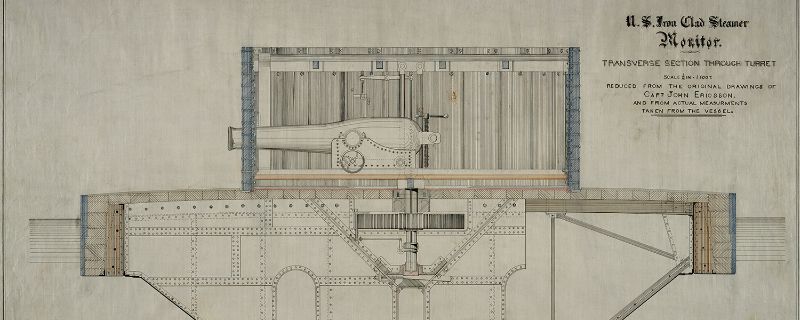
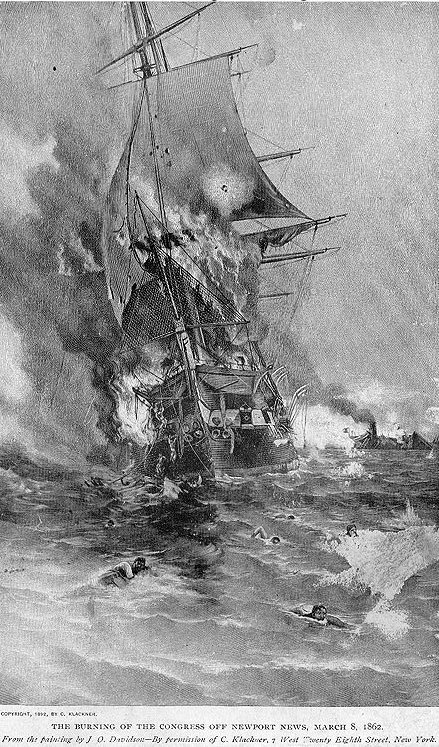
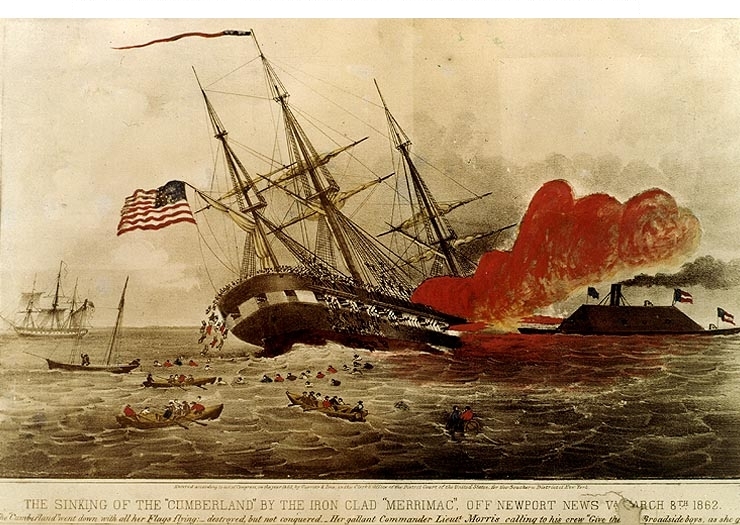
On March 8, 1862, "CSS Virginia" attacked the Union blockading squadron in Hampton Roads, Virginia, destroying “Cumberland” and “Congress”. Early in the battle, “USS Minnesota” ran aground while attempting to engage the "Virginia", and she remained stranded throughout the battle. "Virginia", however, was unable to attack Minnesota before daylight faded.
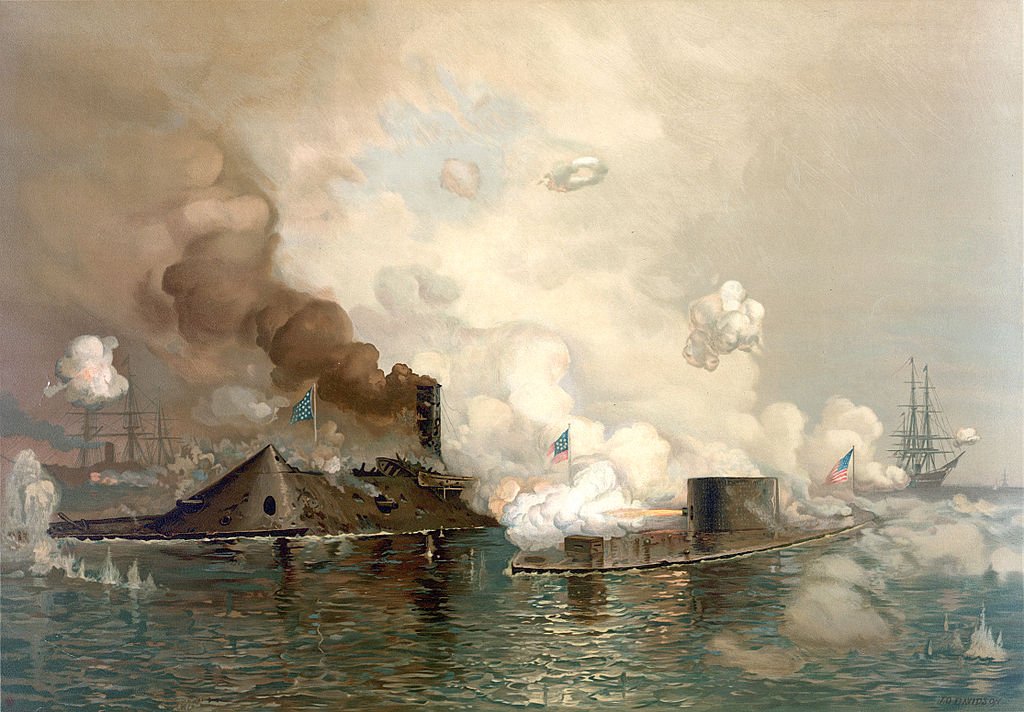
That night, "Monitor" — under the command of Lieutenant John L. Worden — arrived from Brooklyn after a harrowing trip under tow. When "Virginia" returned the next day to finish off Minnesota and the rest of the blockaders, Monitor moved out to stop her. The ironclads fought at close range for about four hours, neither one sinking nor seriously damaging the other. At one point, "Virginia" attempted to ram, but she only struck "Monitor" with a glancing blow that did no damage. It did, however, aggravate the damage done to Virginia's bow from when she had previously rammed Cumberland. "Monitor" was also unable to do significant damage to Virginia, possibly because her guns were firing with reduced charges as ordered by Cmdr John Dahlgren, the gun's designer.
Towards the end of the engagement, "Virginia" by accident hit "Monitor's" pilothouse. Lt. Worden, blinded by shell fragments and gunpowder residue from the explosion, ordered Monitor to sheer off into shallow water. The command passed to the executive officer, Samuel Greene, who assessed the damage and ordered “Monitor” to turn around back into the battle.
Virginia, seeing “Monitor” turn away, turned her attention back to Minnesota. The falling tide, however, prevented her from getting close to the stranded warship. After an informal war council with his officers, “Virginia's” captain decided to return to Norfolk for repairs. “Monitor” arrived back on the scene as "Virginia" was leaving. Greene, under orders to protect Minnesota, did not pursue.
Tactically, the battle between these two ships was a draw, though it could be argued that “Virginia” did slightly more damage to “Monitor” than “Monitor” did to “Virginia". “Monitor” did successfully defend “Minnesota” and the rest of the U.S. fleet while “Virginia” was unable to complete the destruction she started the previous day. Strategically, nothing had immediately changed: the Federals still controlled Hampton Roads and the Confederates held several rivers and Norfolk.
After battle
"USS Monitor" took part in a few small actions but according to Lincoln's orders never again participated in action against “CSS Virginia”. May 15 1862 she engaged Confederate batteries as Drewry's lack of deck protection left her vulnerable to enemy fire. During the summer of 1862, she was modified. She added a slopped glacis to protect the pilot house, fitted the ship with a telescopic smokestack, improved ventilation, davits for handling her boats, and a variety of other changes to enhance her fighting power and habitability.
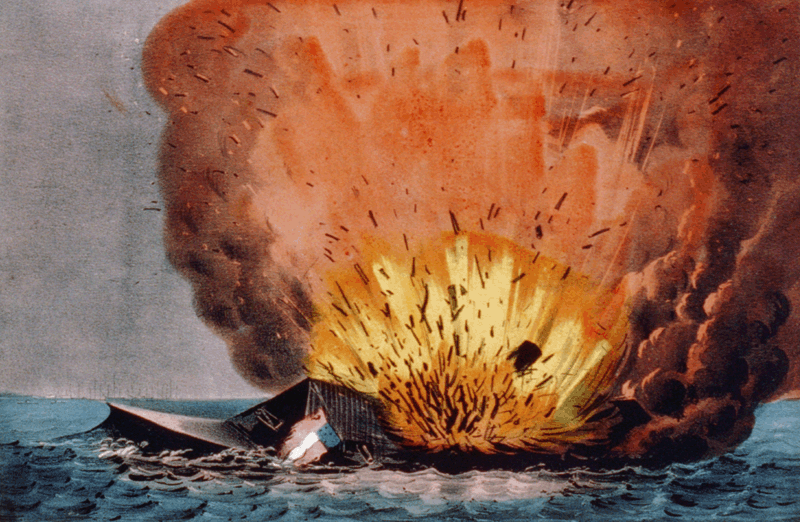
On May 10, 1862, advancing Union troops occupied Norfolk, "Virginia" was unable for ocean-going travel through the Atlantic. She was also unable to cruise up James River due to her 22 feet. In this situation, her flag officer Jasiah Tattnal decides to destroy "CSS Virginia" to prevent capture. The guns of the "CSS Virginia" have been removed. On May 11, 1862, the fate of "CSS Virginia" ended in a great explosion.
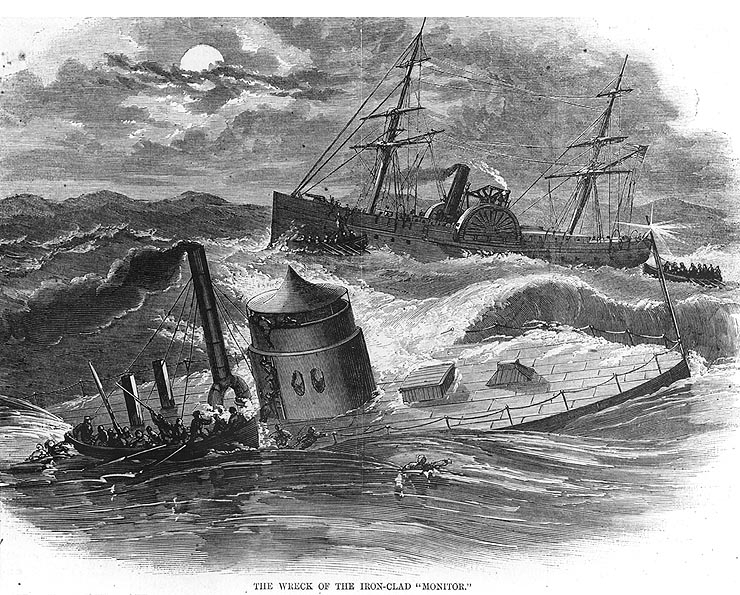
Because there were no duties for her at Hampton Road after she was towed to join the blockade forces off the Carolinas. Unfortunately USS “Monitor” met a big storm and sank. 16 men from her crew have been lost. While the design of “Monitor” was well-suited for river combat, her low freeboard and heavy turret made her highly unseaworthy in rough waters. The wreck now forms a protected Federal Marine Sanctuary.
Based on:
Krzysztof Michałek, Pod banderami Unii i Konfederacji, Warszawa 1996, .
Tadeusz Klimczyk, Historia Pancernika s.16Angus Konstam, Union Monitor 1861-65. Osprey Publishing, s.
Marek Jarosz, USS Monitor, Okręty Wojenne nr 2 / 1993, s. 10.
Joel K. Bourne Jr. Żaglowce poszły w drzazgi. Pierwsza bitwa pancerników. National Geographic Polska Nr 3 (78) Marzec 2006, s. 98.
Krzysztof Michałek, Pod banderami Unii i Konfederacji, Warszawa 1996, s. 209